


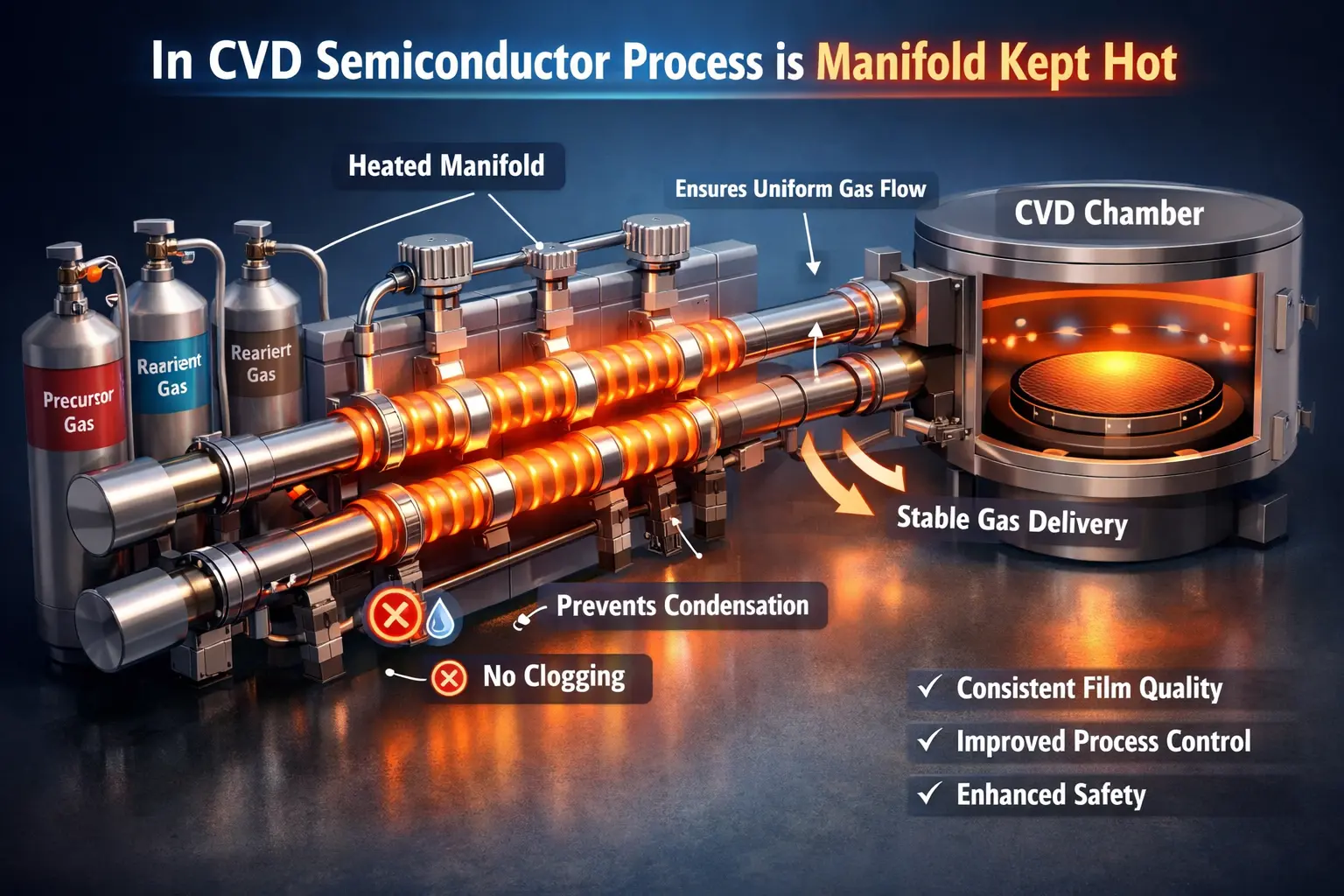
Chemical Vapor Deposition (CVD) is one of the most essential processes in semiconductor manufacturing. It is used to deposit thin films on silicon wafers, forming layers that are crucial for creating integrated circuits. If you are new to this field or just curious about how semiconductor tools maintain consistency, one of the common questions is: in cvd semiconductor process is manifold kept hot? Understanding this is important because it directly impacts the quality, uniformity, and reliability of the final semiconductor products.
What Is a Manifold in CVD and Why It Matters
In a CVD tool, the manifold is the gas distribution system that connects the precursor gas sources to the deposition chamber. It is made of pipes, valves, mass flow controllers, and fittings that ensure the correct gas mixture is delivered to the chamber at precise flow rates. Since CVD processes rely on chemical reactions of gases at high temperatures, any instability in gas delivery can cause defects, contamination, or uneven deposition. This is why many CVD tools use a heated manifold.
When people ask in cvd semiconductor process is manifold kept hot, the answer is usually yes, and the reason is simple: heating ensures stable gas flow and prevents condensation of the precursors inside the system.
Preventing Condensation and Clogging
Most precursor gases used in CVD are either low boiling point liquids or gases that can condense easily at room temperature. When these gases travel through the manifold, the temperature can drop, especially if the system is exposed to cooler ambient conditions. When that happens, the gas may condense on the walls of the manifold.
Condensation can cause many problems:
- Gas lines get blocked
- Flow becomes unstable
- Deposited films become uneven
- Process repeatability decreases
This is why in cvd semiconductor process is manifold kept hot to maintain the gas in vapor form and avoid condensation.
Maintaining Uniform Gas Flow and Stable Pressure
Another important reason the manifold is heated is to maintain uniform gas flow. When gas temperatures change, so does gas density. This affects flow rate, pressure, and the ratio of gases reaching the chamber. For semiconductor manufacturing, even small changes in gas composition can affect film quality and thickness.
Keeping the manifold hot ensures that the gas density remains stable, and the flow is consistent from batch to batch. This is especially important for advanced semiconductor nodes where uniformity and repeatability are critical.
Avoiding Premature Chemical Reactions
Many CVD precursors are chemically reactive. If they cool down too quickly or contact cold surfaces, they may start decomposing or reacting before reaching the chamber. This leads to unwanted particles, contamination, and a decrease in film quality.
In a semiconductor environment, contamination is one of the biggest challenges. Even tiny particles or impurities can cause defects in the wafer. That is why in cvd semiconductor process is manifold kept hot to avoid any premature reaction or decomposition.
Improved Process Control and Consistency
CVD processes require tight control over temperature, pressure, gas flow, and chemical composition. A stable manifold temperature supports this control by providing predictable gas delivery. When the manifold temperature is maintained, the system becomes more stable, and process parameters become repeatable.
This helps manufacturers achieve higher yield and better wafer quality. In other words, heating the manifold is a small step that has a major impact on the final outcome.
Safety and Reliability
Keeping the manifold hot also improves safety. Some precursors are toxic, flammable, or corrosive. If they condense or react inside the manifold, they may create dangerous deposits or blockages that can lead to equipment failure or leaks. Heating the manifold reduces the risk of these issues by ensuring gases stay in their intended state and flow properly.
Reliability is another important factor. Semiconductor fabs run continuously, and any unexpected downtime is costly. By keeping the manifold hot, operators reduce the chances of line blockage and unplanned maintenance.
How Hot Is the Manifold Kept?
The exact temperature varies depending on the type of precursor used. For example, metal-organic precursors may require higher manifold temperatures, while simple gases may not need much heating. In general, the manifold is heated enough to prevent condensation but not so high that it causes premature decomposition.
This careful balance is why many CVD systems use controlled heating with temperature feedback. It ensures the manifold stays at the right temperature throughout the process.
Summary
In the world of semiconductor manufacturing, precision matters. When people ask in cvd semiconductor process is manifold kept hot, the answer is clear: yes, it is kept hot to ensure stable gas flow, prevent condensation, avoid premature reactions, improve process consistency, and maintain safety. A heated manifold is one of the many small details that contribute to the high quality and reliability of modern semiconductor devices.
Conclusion
Heating the manifold in a CVD semiconductor process is a vital step for maintaining process stability and quality. It ensures that precursor gases remain in the correct state, prevents contamination, and supports consistent gas delivery. For modern semiconductor manufacturing, these small details play a major role in producing reliable and high-performance devices.
If you need a more technical version or want this content optimized for a specific semiconductor process (like PECVD or ALD), feel free to ask.
FAQs
1. Why is the manifold heated in CVD tools?
The manifold is heated to prevent gas condensation, maintain stable flow, and improve process repeatability.
2. What happens if the manifold is not kept hot?
Gas may condense, causing blockages, unstable flow, contamination, and uneven film deposition.
3. Does heating the manifold improve wafer quality?
Yes, it ensures consistent gas delivery and improves film uniformity and yield.
4. Is the manifold temperature the same for all precursors?
No, it depends on the type of precursor and its boiling point or reactivity.
5. Does a heated manifold affect safety?
Yes, it reduces the risk of blockage, leakage, and unwanted chemical reactions.
You May Like: Drivingmadio Do a Barrel Roll 2 Times: The Complete Guide for Gamers and Creators
